Togetherness is beating up an empty elevator (organic and inorganic envelopes); Atkins, Bratton, Smith, Jameson, Ballard...


Once upon a time a couple of people were alive who were friends of mine. The weathers, christ, the weathers on those Saturdays. 

And no provision has been made for the casual life in casual freshly-laundered bedclothes.

(Allowing liquids to puddle, importantly)

This one goes to the damp clothes, balled-up and forgotten in the washing machine.

I don’t want to hear any news on the radio about the weather on the weekend.


“The Stack, the megastructure, can be understood as a confluence of interoperable standards-based complex material-information system of systems, organized according to a vertical section, topographic model of layers and protocols. The Stack is a standardized universal section. The Stack, as we encounter it and as I prototype it, is composed equally of social, human and ‘analog’ layers (chthonic energy sources, gestures, affects, user-actants, interfaces, cities and streets, rooms and buildings, organic and inorganic envelopes) and informational, non-human computational and ‘digital’ layers (multiplexed fiber optic cables, datacenters, databases, data standards and protocols, urban-scale networks, embedded systems, universal addressing tables). Its hard and soft systems intermingle and swap phase states, some becoming ‘harder’ or ‘softer’ according to occult conditions. (Serres, hard soft). As a social cybernetics, The Stack that we know and design composes both equilibrium and emergence, one oscillating into the other in indecipherable and unaccountable rhythm, territorializing and de-territorializing the same component for diagonal purposes.” 

 Benjamin Bratton, “On the Nomos of the Cloud: The Stack, Deep Address, Integral Geography,” Nov. 2011 


If everything means something else, then so does technology. It would be a mistake to reduce the menacing object-world of allegorical conspiracies to that first, fresh fear of spy systems and informants in the 1960s, when right-wingers discovered a whole new generation of just the right gadgets and someone was listening to you, but only to you personally. J. Edgar Hoover would make a most anachronistic mascot for late capitalism; while the anxieties about privacy seem to have diminished, in a situation in which its tendential erosion or even abolition has come to stand for nothing less than the end of civil society itself. It is as though we were training ourselves, in advance, for the stereotypical dystopian rigours of overpopulation in a world in which no one has a room of her own any more, or secrets anybody else cares about in the first place.

Fredric Jameson, Totality as Conspiracy, in The Geopolitical Aesthetic; Cinema and Space in the World System, 1995

//


 49. For primitive societies the natural world (which usually changes
   only slowly) provided a stable framework and therefore a sense of
   security. In the modern world it is human society that dominates
   nature rather than the other way around, and modern society changes
   very rapidly owing to technological change. Thus there is no stable
   framework.
   
   50. The conservatives are fools: They whine about the decay of
   traditional values, yet they enthusiastically support technological
   progress and economic growth. Apparently it never occurs to them that
   you can't make rapid, drastic changes in the technology and the
   economy of a society with out causing rapid changes in all other
   aspects of the society as well, and that such rapid changes inevitably
   break down traditional values.


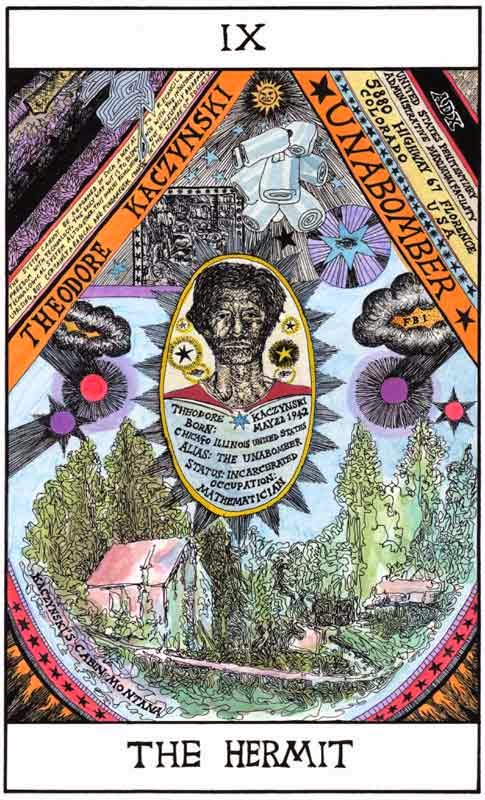
Theodore 'Ted' Kaczynski; Industrial Society and its Future / Unabomber manifesto; 1995


//


“Laing listened to her spirited description of the continuous breakdown of services within the building, the vandalizing of an elevator and the changing cubicles of the 10th-floor swimming-pool. She referred to the high-rise as if it were some kind of huge animate presence, brooding over them and keeping a magisterial eye on the events taking place. There was something in this feeling — the elevators pumping up and down the long shafts resembled pistons in the chamber of a heart. The residents moving along the corridors were the cells in a network of arteries, the lights in their apartments the neurones of a brain.
Laing looked out across the darkness at the brilliantly lit decks of the nearby high-rise, barely aware of the other guests who had arrived and were sitting in the chairs around him-the television newsreader Paul Crosland, and a film critic named Eleanor Powell, a hard-drinking redhead whom Laing often found riding the elevators up and down in a fuddled attempt to find her way out of the building.

“Isn't your apartment next to the elevator lobby?" Laing asked her. "You'll need to barricade yourself in."
"What on earth for? I leave the door wide open." When Laing looked puzzled, she said, "Isn't that part of the fun?"
"You think that we're secretly enjoying all this?"
"Don't you? I'd guess so, doctor. Togetherness is beating up an empty elevator. For the first time since we were three years old what we do makes absolutely no difference. When you think about it, that's really rather interesting…”

Ballard's “High Rise,” 1975

If one wants teamwork he should join the army... Coum, Treister, Smithson


Suzanne Treister Hexen 2.0 Tarot


One way to describe thee moment we wish to capture in our actions is this. Imagine an average living room in a house, probably in a city in Europe. In this room are two people. A man and a woman as it happens, but it could be two men, or two women, ages are not important. They are only figures with no attachment, no specific identity. They sit watching a television set. Black and white. An old film is playing, late at night. In thee Television studio thee old film snaps unexpectedly. A technician pushes aside his coffee and switches to a contingency card apologising for thee loss of picture. This takes only a second, an immeasurable moment. In thee living room there is a moment also. A moment when thee film has stopped, but thee two peoples brains have not registered it has gone, yet thee last visual picture is ended, and thee brain has also not registered thee arrival of new information in thee form of thee contingency card. For this moment neither brain is registering anything, it is too tiny in a way to be accepted as existing, yet in a strange way, it must exist. This moment is what we are interested in with coum.
This moment in time is also thee exact moment when one is neither asleep or awake, thee moment directly before coumplete death when one’s life is said to totally pass before one, both fantasy life, and parafantastical life. Thee moment after/before, or, residual appreciation.

COUM TRANSMISSIONS

//


Dear Mr. Gyorgy Kepes,


I have reconsidered the context of the exhibition* and feel that my art will not fit. To celebrate the power of technology through art strikes me as a sad parody of NASA. I do not share the confidence of the astronauts. The rationalism and logic of the engineer is too self-assured. Art aping science turns into a cultural malaise.The righteousness of "team spirit" is no solution for art. Technology promises a new kind of art, yet its very program excludes the artist from his own art. The optimism of technical progress results in political despair. To many artists of Brazil technology and politics reflect each other. All the "fancy junk" of science cannot hide the void. I am sick of "lighting candles," I want to know what the "darkness" is, I don't "curse" it or praise it, but I know it is there. As rockets go to the moon the darkness around the Earth grows deeper and darker. The "team spirit" of the exhibition could be seen as endorsement of NASA's Mission Operations Control Room with all its crew- cut teamwork. Some Brazilians see the "advances" of technology as a military byproduct. I am withdrawing from the show because it promises nothing but a distraction amid the general nausea. If technology is to have any chance at all, it must become more self-critical. If one wants teamwork he should join the army. A panel called "What's Wrong with Technological Art" might help.


*The United States section of the x Sao Paulo Bienale, September through December 1969, presented by the International Art Program of the National Collection of Fine Arts in collaboration with the Center for Advanced Visual Studies of the Massachusetts Institute of Technology. A group composed of Fellows of the Center was responsible for the development of the exhibition, under the direction of the Center's director, Gyorgy Kepes 


Robert Smithson, “Letter to Gyorgy Kepes (1969)” in Robert Smithson: The Collected Writings, Jack Flam, ed. (Berkeley: University of California Press, 1996), 369.

donald rumsfeld is a moon child and i respect that...


[....] 
the woman reading might well be reading the horoscope of louis philippe poire what’s up LP? you are currently dealing with a situation that is riddled with unquantifiable unknowns this is starting to sound like rumsfeld just like rumsfeld reports that say that something hasn't happened are always interesting to me because as i know there are known knowns there are things i know we know i also know there are known unknowns i know there are some things we do not know not to mention there are unknown unknowns the ones i don't know we don't know donald was born on july 9 making him a cancer i don’t mean that ironically he’s not so bad but systemic rot is not the same as a few bad apples people born under cancer are called moon children donald is a moon child and i respect that i get all my astrological information from wikipedia  and i’ve been noticing that some astrological signs have extensive pages  and others are quite bare meaning perhaps one thing we can say is that some astrological signs are just not into editing wiki pages i can’t tell you why but i will tell you that apparently people born under cancer can  
[...]


I) if you're not that into horoscopes 
II) donald rumsfeld is a moonchild and I respect that 
III) amazon is incorporated 
IV) the hamburger is going into retirement


Heavy is the head that wears the crown i.e. Nevada may have laughed, but now Samsung is laughing at Nevada; Dodge, Lavier, Steinbach...


 Haim Steinbach, charm of tradition, 1985


Bertrand Lavier, Beaunotte/Nevada, 1989 


Jason Dodge, Darkness Falls on Wolkowyja 74, 38-613 Polanczyk, Poland, 2005, 
all of the light bulbs, candles, matches, and anything that illuminates 
are taken from a house at the edge of a forest in Poland, 2005


A current of organic life surges from these communal groups -- which share a common destiny -- to their ornaments, endowing these ornaments with a magic force and burdening them with meaning to such an extent that they cannot be reduced to a pure assemblage of lines. Those who have withdrawn from the community and consider themselves to be unique personalities with their own individual souls also fail when it comes to forming these new patterns. Were they to take part in such a performance, the ornament would not transcend them. 

Siegfried Kracauer


the charm of tradition


As the 1960s began to lengthen into the 1970s and "sculpture" began to be piles of thread waste on the floor, or sawed redwood timbers rolled into the gallery, or tons of earth excavated from the desert, or stockades of logs surrounded by firepits, the word sculpture became harder to pronounce-but not really that much harder. The historian/critic simply performed a more extended sleight-of-hand and began to construct his genealogies out of the data of millennia rather than decades. Stonehenge, the Nazca lines, the Toltec ballcourts, Indian burial mounds – anything at all could be hauled into court to bear witness to this work's connection to history and thereby to legitimise its status as sculpture. Of course Stonehenge and the Toltec ballcourts were just exactly not sculpture, and so their role as historicist precedent becomes somewhat suspect in this particular demonstration. But never mind. The trick can still be done by calling upon a variety of primitivising work from the earlier part of the century – Brancusi's Endless Column will do – to mediate between extreme past and present. 

Rosalind Krauss


something about J.G. Ballard


Lavier. Who is ~? The rock is Nevada you think and the refrigerator is Beaunotte? which is kind of like beautiful-night in franco-italian and a fittingly smooth name for whitegoods but would sound like Bo-notty if we really transposed the accent and so would sound like a ghettoblaster or someone's nickname. This is like fractions. Beaunotte over Nevada. Beaunotte is a rock from Beaunotte, a department in the east of France, and Nevada is a refrigerator brand and now obsolete. Nevada. So many myths of the American west to stuff under only three syllables. Umbrella concept. And so land-art and earthworks, Heizer in Hiko. Beaunotte's population has been steadily declining since the end of the 19th century. Only 21 people were left in 2012. What does that mean for the Beaunotte on the fridge, so far from home? Not much. A stone could outlast them all and Beautiful Night has as good a chance as any other. Also monoliths are irreducibly ambiguous i.e. Nevada may have laughed but now Samsung is laughing at Nevada i.e. heavy is the head that wears the crown. Hello Mark Leckey. 


"Small and quiet time voices auto-tune complaint." Leckey, Smithson, Pynchon...


"Instead of causing us to remember the past like the old monuments, the new monuments seem to cause us to forget the future. Instead of being made of natural materials, such as marble, granite, or other kinds of rock, the new monuments are made of artificial materials, plastic, chrome, and electric light. They are not built for the ages, but rather against the ages. They are involved in a systematic reduction of time down to fractions of seconds, rather than in representing the long spaces of centuries. Both past and future are placed into an objective present. This kind of time has little or no space; it is stationary and without movement, it is going nowhere, it is anti-Newtonian, as well as being instant, and is against the wheels of the time-clock."


“KekulĂ© dreams the Great Serpent holding its own tail in its mouth, the dreaming Serpent which surrounds the World. But the meanness, the cynicism with which this dream is to be used. The Serpent that announces, "The World is a closed thing, cyclical, resonant, eternally-returning," is to be delivered into a system whose only aim is to violate the Cycle. Taking and not giving back, demanding that "productivity" and "earnings" keep on increasing with time, the System removing from the rest of the World these vast quantities of energy to keep its own tiny desperate fraction showing a profit: and not only most of humanity—most of the World, animal, vegetable, and mineral, is laid waste in the process. The System may or may not understand that it's only buying time. And that time is an artificial resource to begin with, of no value to anyone or anything but the System, which must sooner or later crash to its death, when its addiction to energy has become more than the rest of the World can supply, dragging with it innocent souls all along the chain of life."

Peter Halley, Two Cells with Conduit & Underground Chamber, 1983


August KekulĂ© discovered the shape of the benzene ring after having a dream of a snake biting its own tail. The ouroboros. A timeless cycle in service of time. New monuments against time. Time with no more space. "Small and quiet time voices auto-tune complaint." The time of the lonely monolith. The age of the ouroboros-qua-petroleum. Aromatic single take. 


Mark Leckey, GreenScreenRefrigerator Parts I & II, 2010

A Sedimentation of the Mind: Earth Projects, in The Writings of Robert Smithson, Nancy Holt ed., 1979

Thomas Pynchon, Gravity's Rainbow, 1973

the profound fascination of the sick man with the isolated and insignificant; BĂ¼rger, Benjamin


As one attempts to analyse the allegory concept into its components, the following schema results: 1. The allegorist pulls one element out of the totality of the life context, isolating it, depriving it of its function. Allegory is therefore essentially fragment and thus the opposite of the organic symbol. "In the field of allegorical intuition, the image is a fragment. a rune. ... The false appearance (Schein) of totality is extinguished" (Origin, p. 176). 2. The allegorist joins the isolated reality fragments and thereby creates meaning. This is posited meaning; it does not derive from the original context of the fragments. Benjamin interprets the activity of the allegorist as the expression of melancholy. "If the object becomes allegorical under the gaze of melancholy, if melancholy causes life to flow out of it and it remains behind dead but eternally secure, then it is exposed to the allegorist, it is unconditionally in his power. That is, it is now quite incapable of emanating any meaning or significance of its own; such significance as it has, it acquires from the allegorist" (Origin, pp. 183-84). The allegorist's traffic with things is subject to a constant alternation of involvement and surfeit: "the profound fascination of the sick man with the isolated and insignificant is succeeded by that disappointed abandonment of the exhausted emblem" (p. 185). Benjamin also addresses the sphere of reception. Allegory, whose essence is fragment, represents history as decline: "in allegory, the observer is confronted with the 'facies hippocratica' (the death mask) of history as a petrified primordial landscape" (p. 166). 

[...]


The second (reception-aesthetic) interpretation of allegory Benjamin advances (and according to which it represents history as natural history, that is, as the fated history of decline) seems to permit application to the art of the avant-garde. If one takes the attitude of the Surrealist self as the prototype of avant-gardiste behaviour, one will note that society is here being reduced to nature. The Surrealist self seeks to recover pristine experience by positing as natural the world man has created. But this means making social reality immune from any idea of possible change. It is not so much that the history man made is transformed into natural history as that it turns into a petrified image of nature. The metropolis is experienced as enigmatic nature in which the Surrealist moves as primitives do in real nature: searching for a meaning that allegedly can be found in what is given. Instead of immersing himself in the secrets of man's making of this second nature, the Surrealist believes he can wrest meaning from the phenomenon itself. The change in function that allegory has passed through since the Baroque is undoubtedly considerable: the Baroque depreciation of the world in favor of the Beyond contrasts with what one can only call an enthusiastic affirmation of the world. But a closer analysis of the artistic methods and procedures shows this affirmation to be imperfect, the expression of a fear of a technique that has become too powerful, and of a social organisation that severely restricts the individual's scope. 


Peter BĂ¼rger
Kai Althoff

actually this is a bit hazukashii sentence... bondage beautiful sweats and nioi-zuke atmospherics


  and is making some smells which is not Japanese ones.... 

actually this is a bit hazukashii sentence...


Hito Steyerl's Lovely Andrea, 2007, showed as part of the vidĂ©othèque Ă©phĂ©mère << Inventer le Possible>> running from 14 October - 8 February at Jeu de Paume, Paris, hither>> _hazukashii - ashamed, embarrassed (shameful, embarrassing, awkward)_


Excerpts from Haruo Shirane's article Matsuo Basho and The Poetics of Scent, published in '92 in the Harvard Journal of Asiatic Studies


It would have to be content with being treated so badly for it would not deserve anything better, since even reveries are better than its own emptiness; the world behind the world


"We see that in the inner world of appearance, the Understanding in truth comes to know nothing else but appearance . . . This curtain [of appearance] hanging before the inner world is therefore drawn away, and we have the inner being [the 'I'] gazing into the inner world . . . It is manifest that behind the so-called curtain which is supposed to conceal the inner world, there is nothing to be seen unless we go behind it ourselves, as much in order that we may see, as that there may be something behind there which can be seen."

Hegel; Phenomenology of the Spirit 

Many little negotiations of private / Interest embalmed with my love; Music for Porn


Attitudes of duty & debt esoteric
Securities fundamentalist pop
– ulisms negating politics like so
Many little negotiations of private
Interest embalmed with my love
My poems service you as well as
Waste demands what’s deepest re
– mains a delicate pumping sensation
Feeling this can’t mean this
                                                 — difference hasn’t yet begun

… common sense itself becomes a kind of pornography expropriation of my most intimate relations just as pornography becomes a kind of common sense everything bearing visible value, everything erasing the relations that produce it. So one must speak in the pornographic even as one speaks against it …

My own stench being what attracts me
To undressing you mean what I think I
–’m feeling dismembered in the touch
I still can’t touch or say the names fall out
For what’s not mine to name you softer
Targets yrs I want to sing what will have
Been my body where yr odor clings I hang
In excess of the system where we’re caught
                               — not sensing the thing that’s sensing us.


Music for Porn - Rob Halpern

Nightboat Books 2012