Showing posts with label suzanne treister. Show all posts

ALCHIMIE_DISCURSIVE_OU_NÉCRO_ÉTHIQUE<>? _THÉORIE_DU_DRONE


« On peut y voir l’aboutissement d’un désir ancien, qui anime toute l’histoire des armes balistiques : accroître son allonge de sorte de pouvoir atteindre l’ennemi à distance, avant que celui-ci ne soit en mesure de le faire. Mais la spécificité du drone tient à ce qu’il joue sur un autre segment de distance. Entre la gâchette, sur laquelle on a le doigt, et le canon, d’où la balle va sortir, s’intercalent désormais des milliers de kilomètres. A la distance de la portée – distance de l’arme à sa cible – s’ajoute celle de la télécommande – distance de l’opérateur à son arme ». (p. 23)

« Cette tentative d’éradication de toute réciprocité dans l’exposition à la violence dans l’hostilité reconfigure non seulement la conduite matérielle de la violence armée, techniquement, tactiquement, psychiquement, mais aussi les principes traditionnels d’un ethos militaire officiellement fondé sur la bravoure et l’esprit de sacrifice. À l’aune des catégories classiques, le drone apparaît comme l’arme du lâche ». (p. 30)


« Cela n’empêche pas ses partisans de la proclamer être l’arme la plus éthique que l’humanité ait jamais connue. Opérer cette conversion morale, cette transmutation des valeurs est la tâche à laquelle s’attellent aujourd’hui des philosophes qui oeuvrent dans le petit champ de l’éthique militaire. Le drone, disent-ils, est l’arme humanitaire par excellence. Leur travail discursif est essentiel pour assurer l’acceptabilité sociale et politique de cette arme. Dans ces discours de légitimation, les « éléments de langage » de marchands d’armes et de porte-parole des forces armées se trouvent recyclés, par de grossiers processus d’alchimie discursive, en principes directeurs d’une philosophie éthique de nouveau genre – une « nécro-éthique », dont il est urgent de faire la critique ». (pp. 30-31)

IMAGES : 

« The Magician », Martin Sharp Tarot (1967)
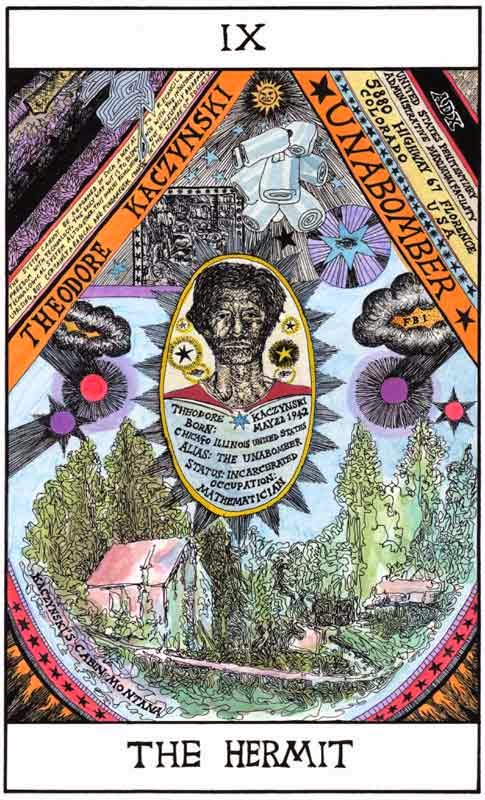
« The Queen of Swords », Hexen 2.0 Tarot de Suzanne Treister (2009-2011)
« The flow of energy through a system acts to organise that system », Whole Earth Catalog, Stewart Brand et al., citation de Norbert Wiener (1968)
« Untitled (p. 180) », Brion Gysin,  William S. Burroughs, (circa 1965)

TEXT :

Grégoire Chamayou, Théorie du drone, Paris : La Fabrique (2013)

ECUSSONS :

Les écussons de l'USAF Pararescue et de l'USAF MQ-9 Reaper drone (la faucheuse)


FUNCTIONS_SO_SOMETHING_CAN_FUNCTION_AND_BECAUSE_SOMETHING_ELSE_FUNCTIONS_


Inger Christensen's It (Det), published by New Directions, translation Susanna Nied.

Suzanne Treister's  Hexen 2039 published by Black Dog, London


If one wants teamwork he should join the army... Coum, Treister, Smithson


Suzanne Treister Hexen 2.0 Tarot


One way to describe thee moment we wish to capture in our actions is this. Imagine an average living room in a house, probably in a city in Europe. In this room are two people. A man and a woman as it happens, but it could be two men, or two women, ages are not important. They are only figures with no attachment, no specific identity. They sit watching a television set. Black and white. An old film is playing, late at night. In thee Television studio thee old film snaps unexpectedly. A technician pushes aside his coffee and switches to a contingency card apologising for thee loss of picture. This takes only a second, an immeasurable moment. In thee living room there is a moment also. A moment when thee film has stopped, but thee two peoples brains have not registered it has gone, yet thee last visual picture is ended, and thee brain has also not registered thee arrival of new information in thee form of thee contingency card. For this moment neither brain is registering anything, it is too tiny in a way to be accepted as existing, yet in a strange way, it must exist. This moment is what we are interested in with coum.
This moment in time is also thee exact moment when one is neither asleep or awake, thee moment directly before coumplete death when one’s life is said to totally pass before one, both fantasy life, and parafantastical life. Thee moment after/before, or, residual appreciation.

COUM TRANSMISSIONS

//


Dear Mr. Gyorgy Kepes,


I have reconsidered the context of the exhibition* and feel that my art will not fit. To celebrate the power of technology through art strikes me as a sad parody of NASA. I do not share the confidence of the astronauts. The rationalism and logic of the engineer is too self-assured. Art aping science turns into a cultural malaise.The righteousness of "team spirit" is no solution for art. Technology promises a new kind of art, yet its very program excludes the artist from his own art. The optimism of technical progress results in political despair. To many artists of Brazil technology and politics reflect each other. All the "fancy junk" of science cannot hide the void. I am sick of "lighting candles," I want to know what the "darkness" is, I don't "curse" it or praise it, but I know it is there. As rockets go to the moon the darkness around the Earth grows deeper and darker. The "team spirit" of the exhibition could be seen as endorsement of NASA's Mission Operations Control Room with all its crew- cut teamwork. Some Brazilians see the "advances" of technology as a military byproduct. I am withdrawing from the show because it promises nothing but a distraction amid the general nausea. If technology is to have any chance at all, it must become more self-critical. If one wants teamwork he should join the army. A panel called "What's Wrong with Technological Art" might help.


*The United States section of the x Sao Paulo Bienale, September through December 1969, presented by the International Art Program of the National Collection of Fine Arts in collaboration with the Center for Advanced Visual Studies of the Massachusetts Institute of Technology. A group composed of Fellows of the Center was responsible for the development of the exhibition, under the direction of the Center's director, Gyorgy Kepes 


Robert Smithson, “Letter to Gyorgy Kepes (1969)” in Robert Smithson: The Collected Writings, Jack Flam, ed. (Berkeley: University of California Press, 1996), 369.