all these ˘ perfect zones of trust


the bark is filled with 
schizogenous
oleo-gum 
reservoirs
collect read 
that and weep
fear broadens
like odour
the boundary of the 
church
godi s an ornament
that extends abody


i will say catherine wheel
but think hygiene
all these ˘ 
perfect zones of trust
people kiss the earth in thanks
it is something i am aware
feel on my skin


dying on the spore if i feel lucky
i flee feel if i feel lucy say =d no d
a sad d
day for me too
on a 
whim 


the pitch to drop
yet and charms n
strange and
schrödinger's c)T
in between and you
ask me for the time
srs
stuff
i cannot answer
to you


all nations revel 


we are always non-official wastrels if 
i am sorry for your loss


i will say this
new body language
requires architects and 
linguists to stop their war


external mental surrogates (a baby in a jelly tethered by several cords)


domestic dream machine
molly is pulling an exit scam
FE everything and 
forget everything
all about it


the bottom floor of the MoMA is
housing an exhibition by Olafur 
Eliasson this generation’s JeFKoons
and post-fordist wunderkind get this
four rotating gospel choirs perform for 
eight hours straight in a room solely
illuminated by clap-activated lamps


there are my teen-surrogates free-floating
on wheatgrass shots and fish oil gel caps
my mental states are healthy wealthy 
and wise and i will adopt er, whatever
as i see fit they are so beautiful

drip drip ladies shoes, code, clues, cryptic lyf


CRYPTIC LYF (for sati)


the man with a bag of melons
meloned to bursting
yeah him

when blue plastic strains
against thick melon materiality
you’re on my mind

and when pink plastic
and when white plastic

all black plastic

the splitting bag is my way
of telling you
it’s you

from a closed window
from a distance of two floors
from someone else’s bed

what will i do when they
ban shopping bags: all
proliferations of my message?

the communicational
structure’s tensegrity 
will simply collapse

cigarettes are already on 
the wane nothing withstands
the happiness-health industry

google’s jolly fellow says
yeah him, i got the memo
no more smoke rings 

ok ok

i can’t use sodium lamps
too uniform ubiquitous
and they already signal 

everything

looking at the entrails of birds
is unfashionable all that
occupational health & safety!

wifi is everywhere dial-up 
is no longer erratic you no 
longer find me in the trills brrreeeee

bbbrrrrrr ddddeeeee

formlessness trumps formation
industrial smog as symptom
of a collective brown study

one earth hour for buyer's remorse
city looks so pretty from z sky
and all very cockney moody

ok ok 

just the melons then
1999 put your lights on


CLUES < GINZBURG >

Wind's writing about Morelli has attracted the attention of scholars to a long-neglected passage of Freud's famous essay The Moses of Michelangelo (1914). At the beginning of the second paragraph, Freud writes: "Long before I had any opportunity of hearing about psychoanalysis, I learnt that a Russian art-connoisseur, Ivan Lermolieff, had caused a revolution in the art galleries of Europe by questioning the authorship of many pictures, showing how to distinguish copies from originals with certainty, and constructing hypothetical artists for those works of art whose former supposed authorship had been dis- credited. He achieved this by insisting that attention should be diverted from the general impression and main features of a picture, and he laid stress on the significance of minor details, of things like the drawing of the fingernails, of the lobe of an ear, of aureoles and unconsidered trifles which the copyist neglects to imitate and yet which every artist executes in his own characteristic way. I was then greatly interested to learn that the Russian pseudonym concealed the identity of an Italian physician called Morelli, who died in 1891. It seems to me that his method of inquiry is closely related to the technique of psychoanalysis. It, too, is accustomed to divine secrets and concealed things from unconsidered or unnoticed details, from the rubbish-heap, as it were, of our observations (auch diese ist gewohnt, aus gering geschiitzten oder nicht beachteten Ziigen, aus dem Abhub - dem 'refuse' - der Beobachtung, Geheimes und Verborgene zu erraten). "

[…]

But what significance did Morelli's essays have for Freud? Freud himself indicates it: the proposal of an interpretative method based on debris, on marginal data, considered as detectors. This way, details usually considered unimportant or even trivial, "low," could provide the key for understanding the highest product of human spirit: "my opponents," Morelli wrote ironically - just the sort of irony Freud was bound to like - "are pleased to define me as one who is unable to see the spiritual meaning of a work of art and therefore attaches particular importance to outward signs such as the shape of hands, ears, or even, horribile dictu, of such a disagreeable object as the fingernails." Morelli too could have appropriated the Virgilian motto Freud was fond of and had chosen as an epigraph to his Interpretation of Dreams: "Flectere si nequeo Superos, Acheronta movebo. "("If Heaven I cannot bend, then Hell I will arouse!") Besides, these marginal data were revealing, in Morelli's opinion, because they represented a moment in which the artist's subordination to cultural tradition was loosened and replaced by a purely individual trait, which was repeated "as a consequence of habit and almost unconsciously. " Even more than the reference to the unconscious - not exceptional in that period - what is striking here is the identification of the intimate core of artistic personality with elements that are beyond the control of consciousness. 

[…]

At present only etymology reveals the extremely ancient relationship between medical semiotics and other sciences based on the deciphering of signs. The epistemological model that unites them, beyond all differences, probably traces back to divination. This does not imply - as some have asserted - that these particular practices were historically preceded by a general science of signs; far from it. The oracle, the priest, the interpreter of divine language, the medical man (social figures that were for a long time merged into a single individual) obviously are much more ancient than the semiologist or his direct ancestor. 

In this group of sciences one undeniably differs from all the others: philology, the science that deciphers and interprets languages and writings other than those of the gods. Its first development, made possible by the social system of the Greek polis, was a decisive event for the secularization and democratization (potential, at least) of culture. But philology too is a science of signs: and as such it can be included in this group of disciplines, that might be defined as based on signs. What unites them is, 1. their being based on the deciphering of signs; 2. their having as objects individual cases, situations, and documents, inasmuch as they are individual; 3. their attaining a knowledge that implies an inevitable margin of hazardousness, of conjecture. As regards this last point, which is decisive, one should consider the role of conjecture both in the various forms of mantics and in philology.

Carlo Ginzburg, Clues: the Roots of a Scientific Paradigm (1976), pp. 273-288


CODE < ECO >

Any work of art can be viewed as a message to be decoded by an addressee. But unlike most messages, instead of aiming at transmitting a univocal meaning, the work of art succeeds precisely insofar as it appears ambiguous and open-ended. The notion of the open work can be satisfactorily reformulated according to Jakobson’s definition of the “poetic” function of language. Poetic language deliberately uses terms in a way that will radically alter their referential function (by establishing, among them, syntactic relationships that violate the usual laws of the code). It eliminates the possibility for a univocal decoding; it gives the addressee the feeling that the current code has been violated to such an extent that it can no longer help. The addressee thus finds himself in the situation of a cryptographer forced to decode a message whose code is unknown, and who therefore has to learn the code of the message from the message itself. At this point, the addressee will find himself so personally involved with the message that his attention will gradually move from the signifieds, to which the message was supposed to refer, to the structure itself of the signifiers, and by so doing will comply with the demands of the poetic message, whose very ambiguity rests on the fact that it proposes itself as the main object of attention: “This emphasis of the message on its own self is called the poetic function.” When we speak of art as an autonomous process, as form for form’s sake, we are stressing a particular aspect of the artistic message which communication theory and structural linguistics would define as follows: “The set (Einstellung) toward the MESSAGE as such, focus on the message for its own sake, is the POETIC function of language.”

Umberto Eco, The Structure of Bad Taste (1989), pp. 195-6


1:48 >> 50:35


HI-NRG SOUL


MEAT EATER - OLIVIA ERLANGER


SOLD-OUT SEMINAR ON CREATIVITY (Mom on a Banderole)


I. Rhythmic Back-Story (the makings of a )

they packed and left in the middle of the night

he got a job selling shoes

she pressed pants in a local dry cleaners

the children read the books they found in the new place

and at night cried quiet soundless

he coughed germs in bas-relief (positive negative sculpture) each stuttering moment in 

time is frozen post-expulsion

in her head

in my head

i’ve found a way back home

his lung particles hang in the air

unsure whether to waft or fall

II. It’s All Over (a flunky life)

the yellow brick road

i cried for tuberculosis when i read about penicillin

haven’t you ever died in a dream and upon waking felt tired of life

going back to sleep as protest / cheaper than banners and paint

renunciation of capitalism in eating dirt and french lentils

i’ve liked you so many times / i mean i really like you

click / endless click / i’ve set the controls to the heart of the son (hi mom)

IV. Admission (I’m just like you, you can be just like me)

i need a break / a small documentary / a tiny novel / a wee cuppa soup

my Esoteric and Occult Online Store is corporatism’s antidote and progeny (EOOS)

the child is the father of the man

V. The First Setback (you will be stabbed in the back, you will come out alive)

he’s sleeping / no one knows why / someone wants to wake him but doesn't dare

he might have pressed pants

or collected his kids from school

instead we’re sitting here holding a crocheted tea cosy between us

talking about ARPANET

the fridge hum pulsing / a rising tide / a phenakistoscope / more stable than it seems

we’re the opposite holding a tea cosy

asleep

coughing a communal bas-relief / someone could make an opera to those arcs

those molecular molehills

VI. Dorothy and Toto (you’ve found your abettor half)

the modern opera is soap / is television / is space

there’s no place like home / there’s no place like home

it’s where the heart is (i’ve set the controls)

i need a tiny novel in a way

in a way there’s nothing like it / except a lie-in / which is rather like it

in another way there’s nothing really like anything really

VII. How to Wake Up Everyday and Love What You Do (HI-NRG soul)

i could search almost anything + aristotle and find something to write about

but it’d be cheap wouldn’t it / probably published in frieze

when aristotle discussed plants etc. / introduce artist’s work / talk about the hot house

of culture / use all plant metaphors / in bas-relief

germs are so stately in gas chromatography

visualising the electromagnetic field is very sexy foreplay

VIII. Look in the Mirror and Say I’m Worth It (everyday’s connected)

the whole world of chemistry comes into the simple act of pressing pants

and coughing

educational toys for the creative child / i see a boom coming

i never think about bust / i’ve liked you so many times / i mean i really like you 


d.t.


Some accidentally produced “little piece of the real” (the dead body) attests to the success of communication. We encounter the same mechanism in fortune telling and horoscopes: a totally contingent coincidence that is sufficient for the effect of transference to take place; we become convinced that “there is something to it.” The contingent real triggers the endless work of interpretation that desperately tries to connect the symbolic network of the prediction with the events of our “real life.” Suddenly, “all things mean something,” and if the meaning is not clear, this is only because it remains hidden, waiting to be deciphered. The real functions here not as something that resists symbolisation, as a meaningless leftover that cannot be integrated into the symbolic universe, but, on the contrary, as its last support. For things to have meaning, this meaning must be confirmed by some contingent piece of the real that can be read as a “sign.” The very word sign, in opposition to the arbitrary mark, pertains to the “answer of the real”: the “sign” is given by the thing itself, it indicates that at least at a certain point, the abyss separating the real from the symbolic network has been crossed, i.e. that the real itself has complied with the signifier’s appeal. In moments of social crisis (wars, plagues), unusual celestial phenomena (comets, eclipses, etc.) are read as prophetic signs.

Žižek, How Real is the Real? in Looking Awry, p.32-33


Togetherness is beating up an empty elevator (organic and inorganic envelopes); Atkins, Bratton, Smith, Jameson, Ballard...


Once upon a time a couple of people were alive who were friends of mine. The weathers, christ, the weathers on those Saturdays. 

And no provision has been made for the casual life in casual freshly-laundered bedclothes.

(Allowing liquids to puddle, importantly)

This one goes to the damp clothes, balled-up and forgotten in the washing machine.

I don’t want to hear any news on the radio about the weather on the weekend.


“The Stack, the megastructure, can be understood as a confluence of interoperable standards-based complex material-information system of systems, organized according to a vertical section, topographic model of layers and protocols. The Stack is a standardized universal section. The Stack, as we encounter it and as I prototype it, is composed equally of social, human and ‘analog’ layers (chthonic energy sources, gestures, affects, user-actants, interfaces, cities and streets, rooms and buildings, organic and inorganic envelopes) and informational, non-human computational and ‘digital’ layers (multiplexed fiber optic cables, datacenters, databases, data standards and protocols, urban-scale networks, embedded systems, universal addressing tables). Its hard and soft systems intermingle and swap phase states, some becoming ‘harder’ or ‘softer’ according to occult conditions. (Serres, hard soft). As a social cybernetics, The Stack that we know and design composes both equilibrium and emergence, one oscillating into the other in indecipherable and unaccountable rhythm, territorializing and de-territorializing the same component for diagonal purposes.” 

 Benjamin Bratton, “On the Nomos of the Cloud: The Stack, Deep Address, Integral Geography,” Nov. 2011 


If everything means something else, then so does technology. It would be a mistake to reduce the menacing object-world of allegorical conspiracies to that first, fresh fear of spy systems and informants in the 1960s, when right-wingers discovered a whole new generation of just the right gadgets and someone was listening to you, but only to you personally. J. Edgar Hoover would make a most anachronistic mascot for late capitalism; while the anxieties about privacy seem to have diminished, in a situation in which its tendential erosion or even abolition has come to stand for nothing less than the end of civil society itself. It is as though we were training ourselves, in advance, for the stereotypical dystopian rigours of overpopulation in a world in which no one has a room of her own any more, or secrets anybody else cares about in the first place.

Fredric Jameson, Totality as Conspiracy, in The Geopolitical Aesthetic; Cinema and Space in the World System, 1995

//


 49. For primitive societies the natural world (which usually changes
   only slowly) provided a stable framework and therefore a sense of
   security. In the modern world it is human society that dominates
   nature rather than the other way around, and modern society changes
   very rapidly owing to technological change. Thus there is no stable
   framework.
   
   50. The conservatives are fools: They whine about the decay of
   traditional values, yet they enthusiastically support technological
   progress and economic growth. Apparently it never occurs to them that
   you can't make rapid, drastic changes in the technology and the
   economy of a society with out causing rapid changes in all other
   aspects of the society as well, and that such rapid changes inevitably
   break down traditional values.


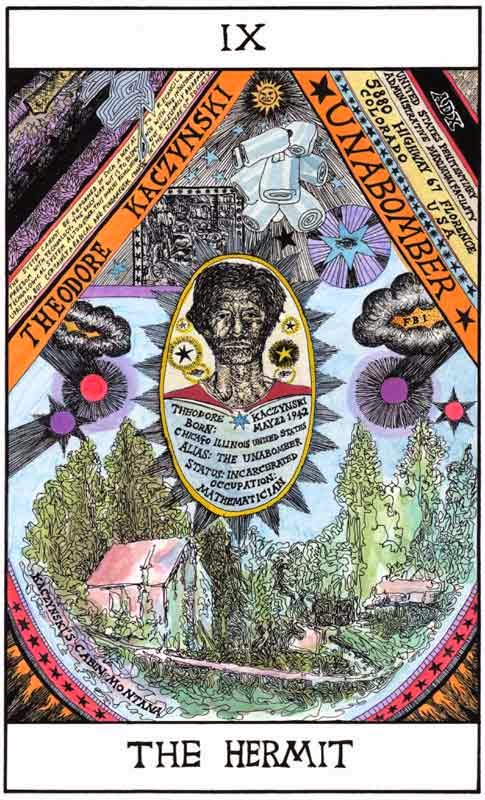
Theodore 'Ted' Kaczynski; Industrial Society and its Future / Unabomber manifesto; 1995


//


“Laing listened to her spirited description of the continuous breakdown of services within the building, the vandalizing of an elevator and the changing cubicles of the 10th-floor swimming-pool. She referred to the high-rise as if it were some kind of huge animate presence, brooding over them and keeping a magisterial eye on the events taking place. There was something in this feeling — the elevators pumping up and down the long shafts resembled pistons in the chamber of a heart. The residents moving along the corridors were the cells in a network of arteries, the lights in their apartments the neurones of a brain.
Laing looked out across the darkness at the brilliantly lit decks of the nearby high-rise, barely aware of the other guests who had arrived and were sitting in the chairs around him-the television newsreader Paul Crosland, and a film critic named Eleanor Powell, a hard-drinking redhead whom Laing often found riding the elevators up and down in a fuddled attempt to find her way out of the building.

“Isn't your apartment next to the elevator lobby?" Laing asked her. "You'll need to barricade yourself in."
"What on earth for? I leave the door wide open." When Laing looked puzzled, she said, "Isn't that part of the fun?"
"You think that we're secretly enjoying all this?"
"Don't you? I'd guess so, doctor. Togetherness is beating up an empty elevator. For the first time since we were three years old what we do makes absolutely no difference. When you think about it, that's really rather interesting…”

Ballard's “High Rise,” 1975

If one wants teamwork he should join the army... Coum, Treister, Smithson


Suzanne Treister Hexen 2.0 Tarot


One way to describe thee moment we wish to capture in our actions is this. Imagine an average living room in a house, probably in a city in Europe. In this room are two people. A man and a woman as it happens, but it could be two men, or two women, ages are not important. They are only figures with no attachment, no specific identity. They sit watching a television set. Black and white. An old film is playing, late at night. In thee Television studio thee old film snaps unexpectedly. A technician pushes aside his coffee and switches to a contingency card apologising for thee loss of picture. This takes only a second, an immeasurable moment. In thee living room there is a moment also. A moment when thee film has stopped, but thee two peoples brains have not registered it has gone, yet thee last visual picture is ended, and thee brain has also not registered thee arrival of new information in thee form of thee contingency card. For this moment neither brain is registering anything, it is too tiny in a way to be accepted as existing, yet in a strange way, it must exist. This moment is what we are interested in with coum.
This moment in time is also thee exact moment when one is neither asleep or awake, thee moment directly before coumplete death when one’s life is said to totally pass before one, both fantasy life, and parafantastical life. Thee moment after/before, or, residual appreciation.

COUM TRANSMISSIONS

//


Dear Mr. Gyorgy Kepes,


I have reconsidered the context of the exhibition* and feel that my art will not fit. To celebrate the power of technology through art strikes me as a sad parody of NASA. I do not share the confidence of the astronauts. The rationalism and logic of the engineer is too self-assured. Art aping science turns into a cultural malaise.The righteousness of "team spirit" is no solution for art. Technology promises a new kind of art, yet its very program excludes the artist from his own art. The optimism of technical progress results in political despair. To many artists of Brazil technology and politics reflect each other. All the "fancy junk" of science cannot hide the void. I am sick of "lighting candles," I want to know what the "darkness" is, I don't "curse" it or praise it, but I know it is there. As rockets go to the moon the darkness around the Earth grows deeper and darker. The "team spirit" of the exhibition could be seen as endorsement of NASA's Mission Operations Control Room with all its crew- cut teamwork. Some Brazilians see the "advances" of technology as a military byproduct. I am withdrawing from the show because it promises nothing but a distraction amid the general nausea. If technology is to have any chance at all, it must become more self-critical. If one wants teamwork he should join the army. A panel called "What's Wrong with Technological Art" might help.


*The United States section of the x Sao Paulo Bienale, September through December 1969, presented by the International Art Program of the National Collection of Fine Arts in collaboration with the Center for Advanced Visual Studies of the Massachusetts Institute of Technology. A group composed of Fellows of the Center was responsible for the development of the exhibition, under the direction of the Center's director, Gyorgy Kepes 


Robert Smithson, “Letter to Gyorgy Kepes (1969)” in Robert Smithson: The Collected Writings, Jack Flam, ed. (Berkeley: University of California Press, 1996), 369.